Hell Bent
reclaiming a spirituality of love


In Liturgies for Resisting Empire, I write about one of empire’s most enduring ideologies—one that has seeped so deeply into us we barely notice it: its obsession with conquering.
Throughout history, empire’s drive to conquer has been explicit in the literal seizing of land and bodies, especially women’s bodies (I explore this more in the book). But the mindset persists. Next week is Thanksgiving, and American culture still glorifies conquest while minimizing the violence of the European invasion of North America. Think of the classroom pageants where kids wear feathered headdresses and paper Pilgrim hats, reenacting a peaceful feast that never existed. This sanitized story is not only inaccurate—it’s harmful. It erases five centuries of brutality against Native peoples.
This celebration of conquest has deep roots. In ancient Rome, emperors staged extravagant triumphal processions—public spectacles that humiliated the conquered and glorified Rome’s military reach. The famous slogan veni, vidi, vici (“I came, I saw, I conquered”) still echoes today, woven into our language, our imagination, even our worship. Christians still celebrate a triumphant Savior who overpowers enemies by force. Some of our favorite worship songs have us singing about battles and victory, glorifying triumph and conquest.
This logic shows up everywhere. We treat grief like a finish line, assuming healing arrives once we “conquer” the final stage. We live in a culture fixated on destinations, so focused on where we think we should end up that we miss the slow, sacred work unfolding in the journey. And Christians, perhaps most of all, have inherited this obsession with arrival. We’ve been so focused on getting to heaven that we forget we are called to bring heaven here.
Which is why our imaginations about hell matter so much. Empire has always needed a theology of conquest—of winners and losers, insiders and outsiders, the saved and the damned. Our visions of hell have often mirrored the empire that shaped them: punitive, violent, obsessed with domination. And rooted in fear.
This is where Brian Recker’s Hell Bent becomes such an important conversation partner. It invites us to interrogate the stories we’ve inherited about punishment, power, and what God actually desires—and to ask whether our theology reflects the kin-dom of God or the conquest of empire.
And I’m thrilled to be able to share an excerpt!
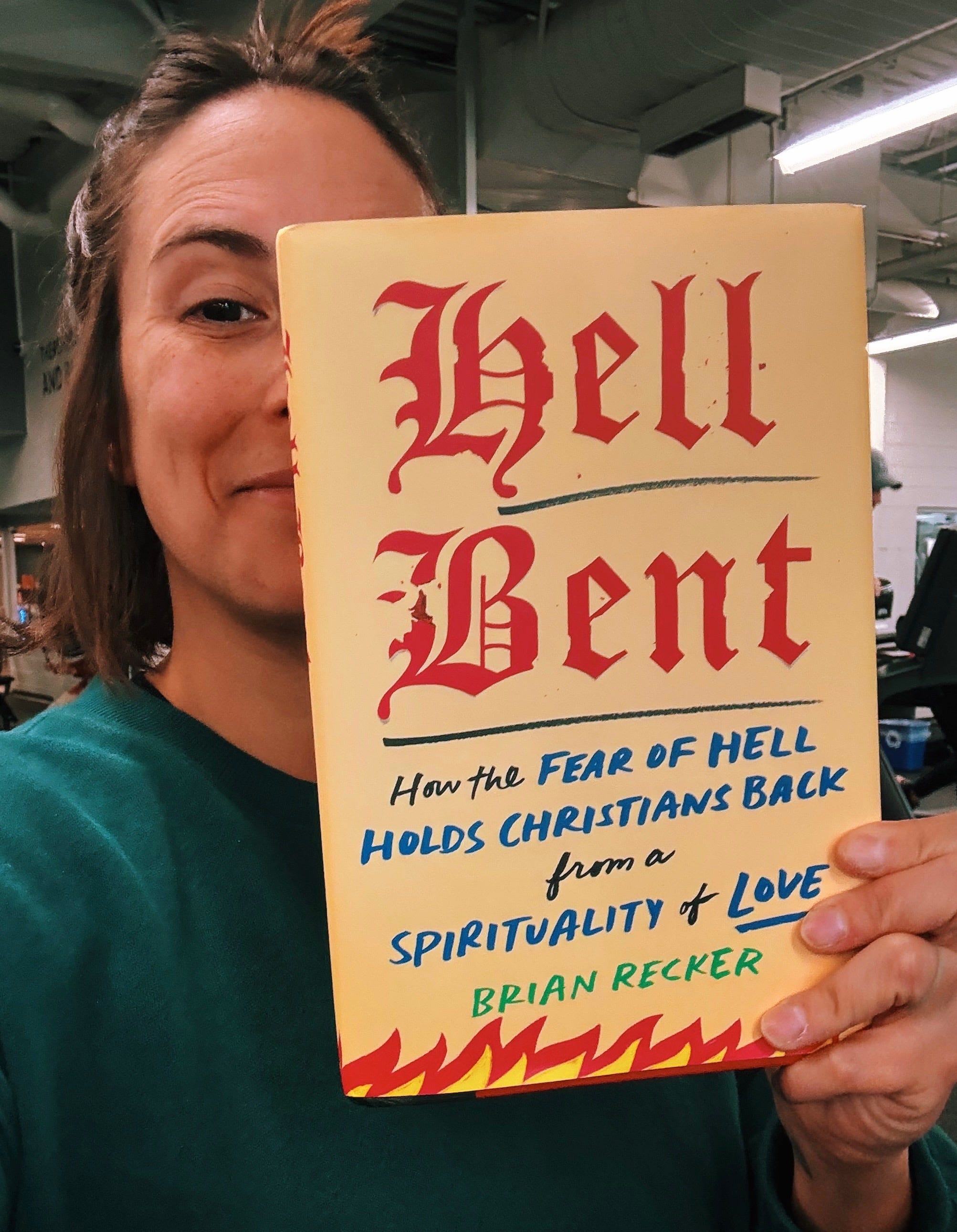
Hell Bent by Brian Recker
IT’S ALL GONNA BURN
This afterlife- focused spirituality continues to shape the way many Christians, particularly evangelicals, view the world and their place in it. I saw this firsthand in my own experiences as an evangelical pastor.
One of my pastoral mentors in evangelicalism was a grizzled man named Tim. He had a habit of constantly muttering vaguely Christian phrases under his breath to himself like mantras, and one of his favorites was “It’s all gonna burn.” I heard him say it whenever he felt a pang of envy over material possessions. For example, he desperately wanted a Harley-Davidson motorcycle, but it was financially out of reach. When he crossed paths with one in real life, he would shake his head and remind himself, “It’s all gonna burn.”
This mindset is common in evangelicalism. This world is going to burn. It’s the next world that’s important.
Now, I don’t want to be too hard on Tim! I think it’s a good thing to remind ourselves of the temporary nature of wealth and possessions. Jesus himself says, “Do not lay up for yourselves treasures on earth, where moth and rust destroy . . . but lay up for yourselves treasures in heaven” (Matthew 6:19– 20, ESV). But for Jesus, heaven is not a place you go to after you die. Rather, heaven is God’s space. It is a spiritual reality, and it is with us and all around us. To lay up treasures in heaven is not about collecting rewards in the afterlife. It is about living for the things of heaven right now. To live for the things that matter most in this world, the things that connect us to love and bring about God’s peace.
In a very literal sense, the world is already burning. Global temperatures are rising, increasing the number of wildfires and other weather- related disasters, and potentially posing a threat to human existence as we know it. Yet I was raised being told that climate change was not important, because even if we do experience ecological disaster, Jesus is coming back soon anyway. The theologian Jürgen Moltmann writes that because Christians have reduced salvation to the afterlife and not this life, we have “unconsciously abandoned nature to its disastrous exploitation by human beings.” If this world is going to burn, it’s because we’re letting it burn. We have abandoned the precious earth God created. We have allowed the exploitation of the garden we’ve been given to tend.
The evangelical response to Trump’s return to power in 2024 reveals how dangerous this disengagement from earthly concerns can be. While some evangelical leaders explicitly endorsed Trump, others engaged in spiritual bypassing, using biblical language to avoid confronting real- world consequences. For example, at a popular evangelical church just two days before this pivotal election, I heard the pastor remind his congregation, “Remember where your citizenship fully and finally lies. . . . We are foreigners and strangers on this earth. . . . Every other allegiance will expire.” While this may sound spiritual and politically neutral, such vague platitudes actually enable oppression by failing to confront it directly and minimizing the importance of our earthly involvement. When over 80 percent of white evangelicals support a race- baiting, fascist- leaning demagogue, speaking in generalities about “heavenly citizenship” without naming and opposing the hatred in the white reactionary Christian movement essentially endorses it.
Being a “citizen of heaven” is indeed a beautiful metaphor, but it doesn’t mean we focus solely on saving souls for the afterlife. It means we are called to represent the values of heaven here on earth. And what that truly means is liberation for the oppressed.
We have a serious problem, and it isn’t in heaven— it’s on earth. It’s in the hospital parking lot where a woman died after being denied miscarriage care due to abortion bans. It’s in our schools, where children drill for the mass shootings we’ve decided are an inevitable part of American life. It’s in the children’s eyes as they are torn from their families at the border. If our heavenly citizenship doesn’t rattle the chains of domination that hang heavy on our brothers and sisters, then it means nothing at all.
Salvation. When you hear this word, what comes to mind? For most of us, it’s the afterlife. It is salvation for the next world, not for this world.
But, at the risk of sounding obvious, once you reject the concept of hell, salvation cannot primarily mean going to heaven. Salvation cannot merely be about “who’s in” and “who’s out” in the next world.
Ultimately, one way or another, everybody’s in. God will be all in all. So salvation is about “this world,” or it doesn’t matter at all. For some people, this makes the idea of salvation seem trivial or unnecessary. They might say, “If everybody goes to heaven, salvation is pointless.” But that is only true if this world and this life are pointless.
If hell is real, then it’s true that this world doesn’t matter very much. The suffering of the world is but the blink of an eye compared to everlasting torment. Our lives in this world are a blip compared to eternity. If there is an eternal hell for the unsaved, then the only valuable purpose of this life is to be “saved” to avoid such a fate. This is slaveholder logic, and it has justified every possible evil under the sun.
But this life is not about escaping hell. There is no hell to escape except the hells we create for ourselves and for others. This life matters. This world, and the suffering in this world, matter. Whatever is on the other side of this (and I believe the eternal arms of love are on the other side of this), we only get one shot at this life. The purpose of this life is not to check the right boxes to get in on the good part of the next life. This life is its own purpose.
And I believe we can find that purpose in Jesus. Jesus showed it to us. He called it the kingdom of God.
 | A guest post by
|
IF YOUR PASTOR isn’t preaching HELL ——- FIRE HIM!
Thanks, Kat and Brian. A good and important word. This part is fire: "Being a 'citizen of heaven' ...doesn’t mean we focus solely on saving souls for the afterlife. It means we are called to represent the values of heaven here on earth. And what that truly means is liberation for the oppressed."