Joy in a World This Broken?
Advent beneath the weight of Herod, empire, and all that aches.

Today is the Third Sunday of Advent, the Sunday where the promise held out to us is joy.
Joy is a strange word to offer in a world like this one.
On Friday night, we gathered with some folks in our community. We had food and Christmas movies. We pushed dining chairs aside and turned the music up—Lake Street Dive and Feliz Navidad filling the room. Our kids danced wildly, their joy unselfconscious and loud. We laughed. We felt grateful. It was the kind of night that settles into your bones and reminds you why friendship matters.
And then we learned that someone who lives not far from us—raised in this country, this state, this city, since he was two years old, never having known any life outside of it—was taken to an ICE detention center in Louisiana. His offense? Being pulled over while driving without a license. He has no criminal record. He’s worked, paid taxes, built a life like any of us. And now he’s being deported to a country he doesn’t remember, a place where he knows no one.
I drive without a license more often than I’d like to admit. Many of us do. The arbitrariness, the cruelty, the sheer inhumanity of it all settles heavy in my chest.
It’s not fair.
This week, a Catholic priest—or someone dressed like one, depending on who you ask—stood up in a House committee meeting and began shouting, “The power of Christ compels you!” at Kristi Noem, the Secretary of Homeland Security. It immediately pulled me back to Ephesians 6 and that call to resist “the tricks of the devil,” the reminder that our struggle is not just against people but against the unseen forces—systems, structures, ideologies—designed to strip the image of God from any of us.
Watching someone go full-blown exorcist in the halls of Congress was unsettling, even surreal. And yet, in a strange way, “biblical”: a religious confrontation erupting in a place built to shield the powerful, directed at one of the very officials helping to uphold the system that terrorizes the vulnerable and innocent.
This morning at church, we saw images of nativity scenes altered to tell the truth we often refuse to see: baby Jesus wrapped in foil emergency blankets, wrists bound with zip ties. Another scene with the manger empty, a sign reading, ICE was here. The Holy Family rendered as detained, disappeared, displaced.
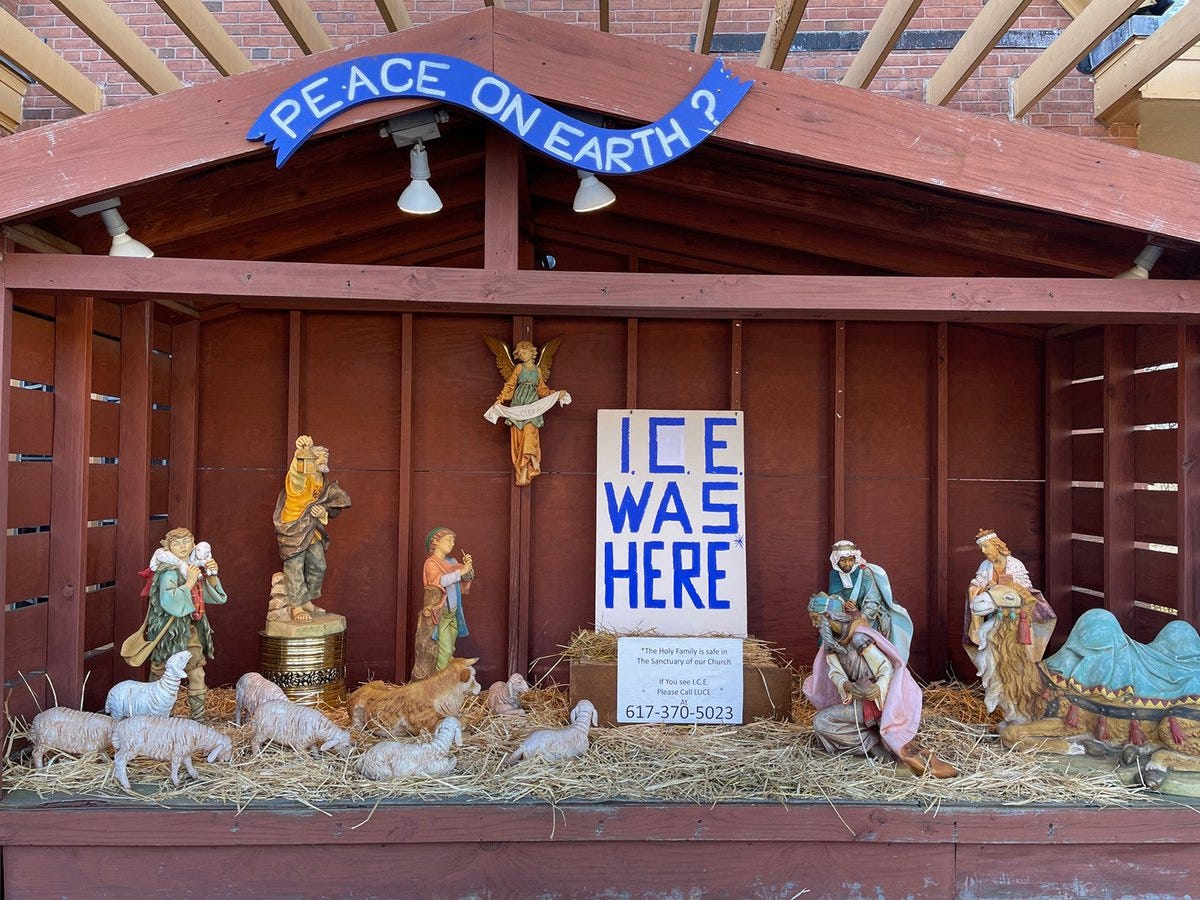
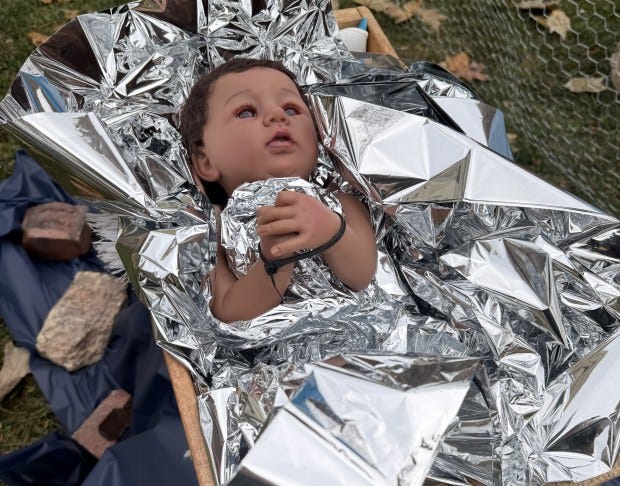
It reminded me of Bethlehem. If you were to visit today, the story we so often sentimentalize would become almost unbearable. The modern city is enclosed by an eight- to nine-meter-high separation wall, with only one entrance and exit. Bethlehem has been transformed into something like a prison. Across the West Bank, the wall snakes through land and livelihoods, separating Israeli settlers from Palestinian families, cutting through olive groves and memories alike.
Street artist Banksy once called Bethlehem “the least Christmassy place on earth.” In 2017—one hundred years after Britain seized control of Palestine—he opened the Walled Off Hotel near Manger Square (where Jesus is believed to have been born), pressed directly against the illegal separation wall. Part hotel, part museum, part protest, it was an act of subversive hospitality, channeling resources back into local Palestinian communities. That same year, Banksy worked with director Danny Boyle to stage an “alternativity”—a reimagining of the nativity meant to expose the sanitized illusions empire feeds us. Palestinian children wore Santa hats and angel wings, singing “Jingle Bells” under drifting fake snow. Joseph received his angelic message by text. Mary, radiant, rode a donkey across the stage. And towering behind it all was the gray concrete wall.
At the end of the video, a woman comments, “Jesus was born here in Bethlehem to bring peace to mankind. Well… let’s say he’s still working on that.” You can see some parents laughing as they brush the fake snow from their hair. Most are weeping.
Last night, we took our kids to a holiday light show with friends. We watched toddlers run beneath glowing arches. We laughed. We sat by a bonfire while our kids roasted marshmallows, sticky hands reaching for warmth and sugar. And as the fire crackled, we talked quietly about grief. About loss. About the people we’ve buried and the people we’re bracing ourselves to lose.
I hugged my children close when we got home and tucked them into bed. I dozed off feeling full and grateful and unbearably heavy all at once.
I woke this morning to news of another mass shooting—this time at Brown University. More lives lost. More bodies terrorized. More families shattered before breakfast. They say not to make it about the guns, but how can you not when there is a devotion to firearms in this country that feels almost sacred, a belief that warfare is the truest measure of strength and security? I keep thinking about Martin Luther King Jr.’s warning: that a nation pouring its wealth into military defense while neglecting the flourishing of its people is not just misguided but inching toward spiritual death. We are not inching. We are catapulting.
Last week, my uncle died—just days before my mom’s birthday. I called her to say happy birthday, but of course it wasn’t “happy.” A few nights later, unable to sleep, I turned on the TV. Univision was showing footage of thousands making their annual pilgrimage to honor La Virgen de Guadalupe. Elderly bodies shuffling forward, some nearly crawling toward the altar in Mexico City. People had traveled for weeks from El Salvador, Guatemala. A journey not marked by comfort or leisure but by survival—and by hope.
And I thought about how, just weeks ago, I traveled across the country to speak about empire and Jesus. Between sermons and workshops, my days were filled with good coffee, good food, warm welcomes. Everyone should have that kind of privilege, I thought.
It’s not fair.
Or maybe I’m the one who’s lacking. Maybe my comforts—the $8 specialty coffees, the ease of it all—do nothing for my soul. Maybe those pilgrimages are the real fullness of life. Maybe that’s what’s true. And all the fluff that cushions my days is what’s quietly wearing me down.
A few days ago, my four-year-old filled a bag with toys she wanted Santa to take to children who “don’t have a family.” She added pajamas too—her favorites—for kids who might be cold at night. She knows something we spend our lives forgetting: that joy always bends toward the other.
We, too, filled bag after bag with things we’ve accumulated over the years—clothes, trinkets, unnecessary stuff. And when I looked at those bags, I felt both lighter and heavier. There was an emptiness in me that felt sacred somehow—looking at the materiality of my life as if it were calling me to repentance.
I wonder if those on pilgrimage ever feel this. We tend to look at people who have less with pity, but I think it’s the engorged who are often lacking.
I remember watching those pilgrimage segments growing up with Abuela often—stories of devotion to la virgen. I know how deeply they resonated with her. She understood that kind of longing, that kind of hope, that kind of endurance. Now she is nearing the end of her life, barely eating, rarely opening her eyes. Her body slowly loosening its grip on this world.
The last time I visited her in her little duplex on the edge of Little Havana, I was flooded with memories of slow afternoons in her backyard, finding lizard eggs in a space that felt enormous to me then and impossibly small now. We didn’t have a house full of things. We had hearts full of grief and joy and each other. And it was always more than enough.
Today is Joy Sunday, and more than ever I’m convinced: there is no true joy without deep grief. I don’t think we can feel one without the other. And the gift of Advent is that it never asks us to choose between them. It insists we hold both.
The incarnation—God breaking into humanity in vulnerability, choosing flesh, choosing dependence, choosing proximity—is a thing worth feeling joyful over. It is God’s refusal of empire’s way of power. God’s declaration that freedom does not come from domination but from presence.
And yet, the incarnation story is not free of Herod. It is not free of state violence. It is not free of infants murdered in the name of security. The all-powerful king feared the newborn “king of the Jews,” and so a mass slaughter of children followed. We rarely talk about that part at Christmas, but it is just as much a part of the story.
Joy arrives in a world that is still dangerous and this Advent, I am not trying to resolve this tension. I am sitting with it. Holding it altogether in the palm of my hand like something small and trembling. I am letting them, joy and grief, speak to one another. Trusting that God is not offended by our inability to feel only one thing at a time.
Joy does not deny the wound. It names it—and it dares to hope anyway.
In the spirit of joy and grief and longing and, well, all the things, I thought I’d do a thing I’ve been wanting to do for a bit now.
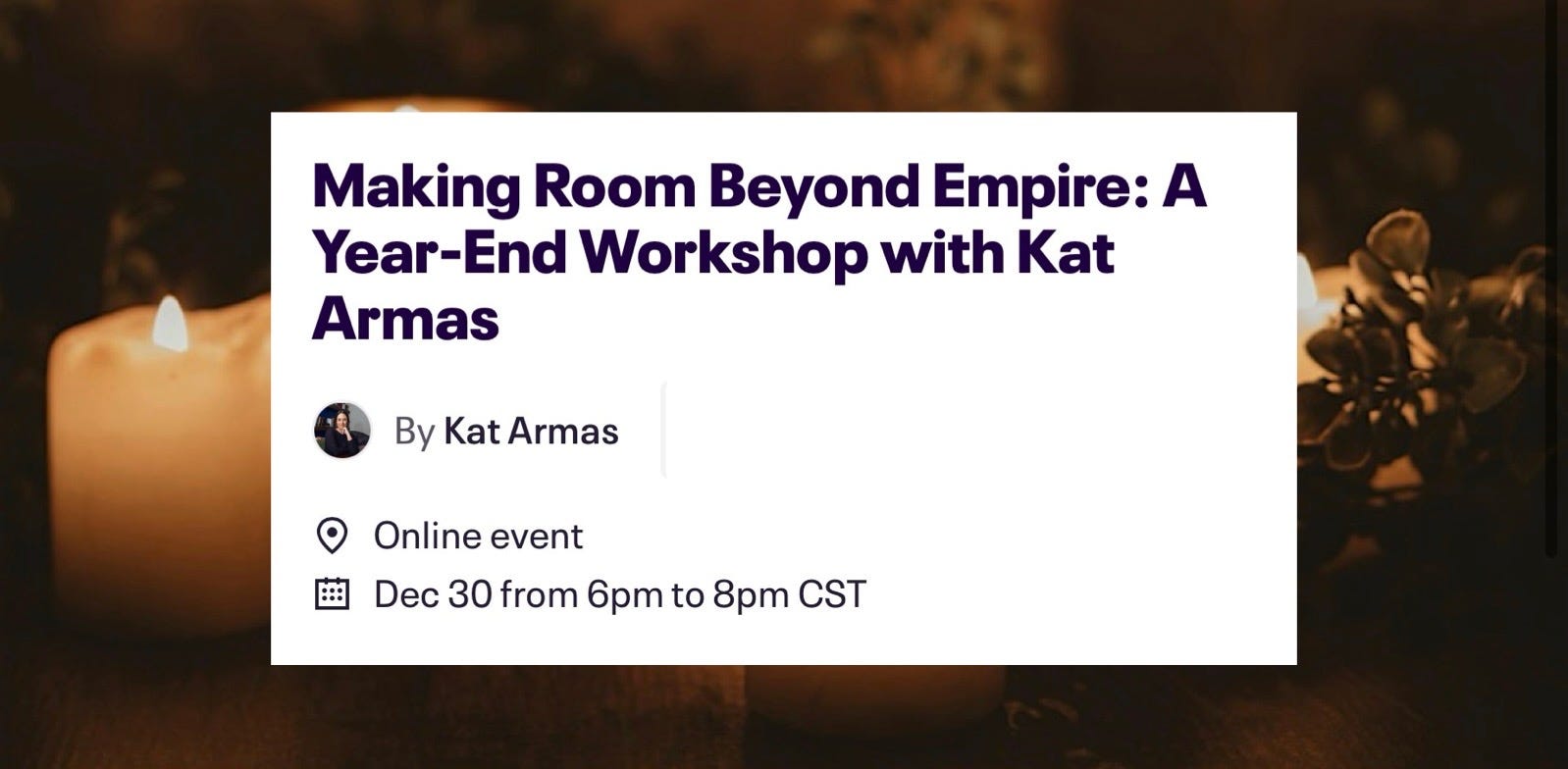
On Tuesday, December 30th at 6pm CT, I’m hosting a year-end time of reflection inspired by my newest book, Liturgies for Resisting Empire, and I’d love for you to join me. Together, we’ll gently name some of empire’s most persistent ideologies and explore how we might loosen their grip on our lives.
This will be a space to breathe, to reflect, to grow—a space to make room for freedom within. So bring your tea, light a candle, settle in. Come ready to connect with others, to engage in an embodied practice, and to close out the year with a bit more clarity, insight, and language for resisting empire.
Space is limited to 10 attendees. Here is the link: Making Room Beyond Empire
I hope to see you there!
Thank you for this writing. I'm savoring your Sacred Belonging, slowly reading chapters (and re-reading some). This is so focused. Joy does not wait till an appropriate time. Joy happens in the midst of it all so love can spread. Thanks for reminding me how joy bends toward others, as your 4 year old knows better than most.